


While many have placed the pandemic squarely in the rear-view mirror, new evidence shows the ways the lockdowns of the early 2020s continue to impact the way we work and commute in Arlington County.
Every three years, the Metropolitan Washington Council of Governments (MWCOG) Commuter Connections conducts a survey of thousands of DC-Area workers to understand their commutes and work experiences. The 2025 survey was administered between March and June 2025. The 2025 regional report was published in January 2026. A subset of this survey data which includes individuals who live and work in Arlington County, was analyzed by Mobility Lab, the research arm of Transportation Resources for Arlington County (TRAC). This post covers some of the new findings from Mobility Lab’s analysis.

Key Findings
Sustained Increases in Telework: In 2025 Arlington workers reported a 213% increase in telework and compressed work schedule (CWS) days compared to 2019.
Reduced Vehicle Quantity: Since 2019, Arlington has seen a 7% decline in reported vehicle quantities. This decline mirrors that of the DC Region as a whole.
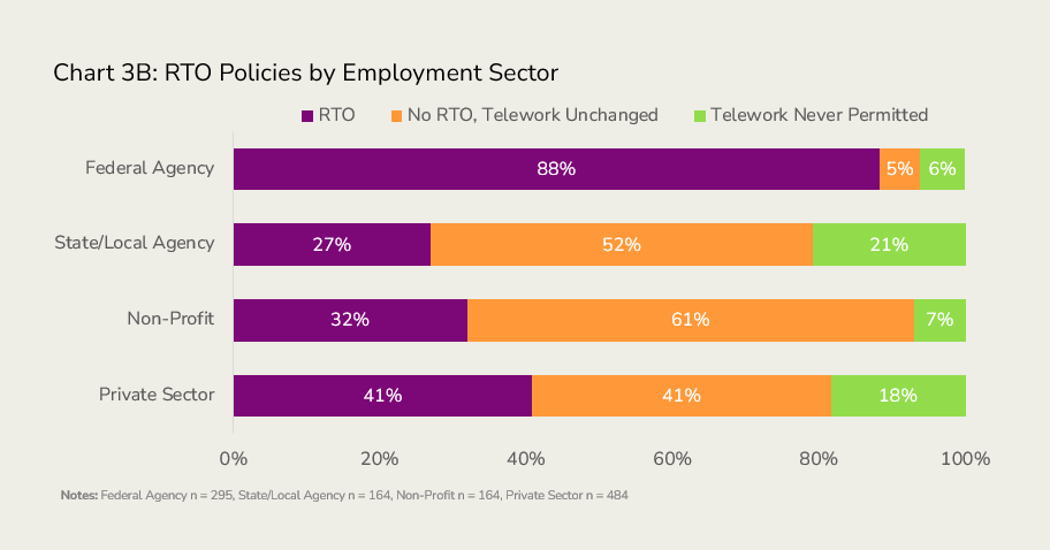
Return to Office (RTO) Orders: Fifty-one percent of Arlington workers reported receiving RTO orders. These orders were disproportionately reported by federal employees, 88% of whom had been ordered back to the office.
Arlington Workers Like Telework: The majority of workers want weekly telework, but there is a mismatch between how many days of telework workers want and how many days companies allow. Workers who have access to telework overwhelmingly report positive experiences.
Arlington Mode Share Over Time
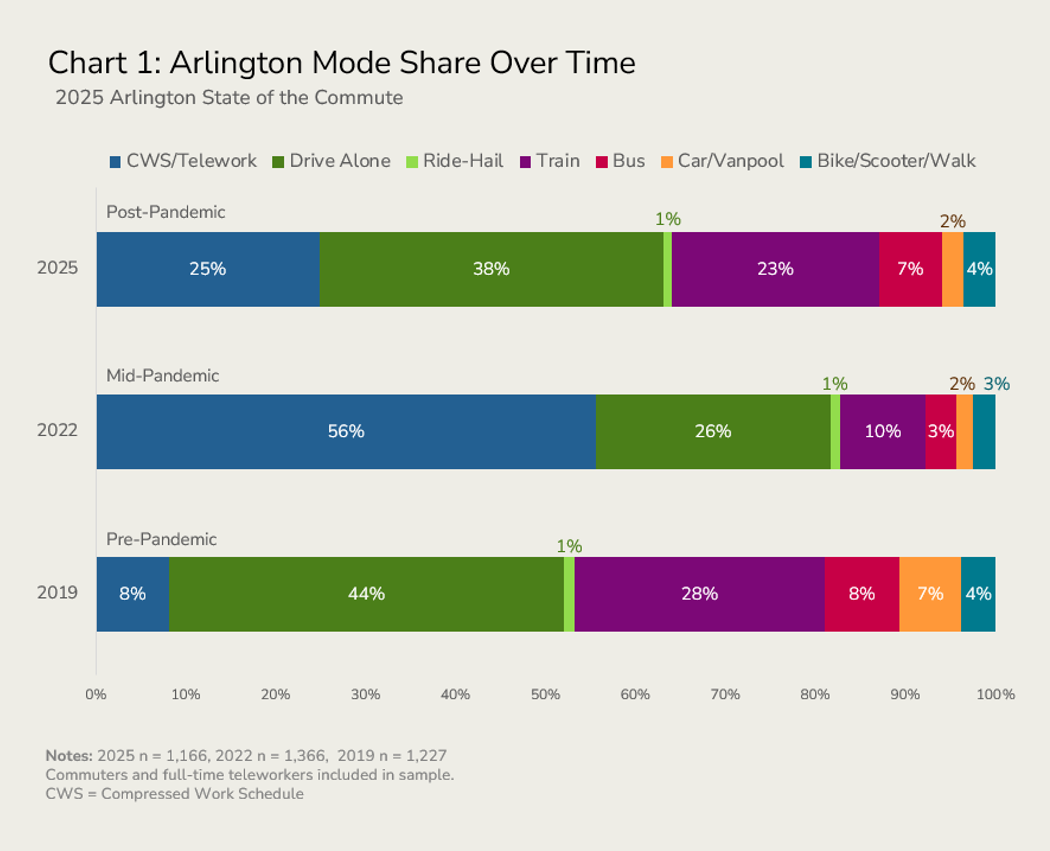
One way to analyze commuting patterns is through weekly commute mode share. To calculate weekly commute mode shares, respondents were asked to identify the mode of transportation they typically use for the longest portion of their commute on each day of a standard five-day workweek. For example, a commuter who usually takes the train Monday through Wednesday, drives alone on Thursday, and teleworks on Friday would have a weekly commute mode share of 60% train, 20% drive alone, and 20% telework. Chart 1 illustrates Arlington's commute mode share over time.
The Covid-19 Pandemic resulted in substantial changes to commute travel patterns. While some shifts have returned to 2019 baseline levels, others have resulted in lasting change. The greatest pandemic-era commute impact was a dramatic increase in teleworking. In the middle of the pandemic in 2022, 56% of commute trips to and from Arlington were replaced by teleworking or compressed work schedule (CWS) days. This reflects a 600% increase over 2019, our pre-pandemic benchmark. By 2025, the total percentage of commute trips replaced by telework dropped to 25% but remain 213% higher than 2019. Though down from their mid-pandemic high, increases in telework and compressed work schedules appear to be an enduring impact of the pandemic era.
In Chart 1, the mode share is calculated using all Arlington workers, including full-time teleworkers. When the mode share is calculated among commuters only (defined as individuals to commute to a workplace outside the home at least one day in an average week, excludes full-time teleworkers), it is easier to track changes among individual modes of transportation. Chart 1B presents Arlington’s mode share with the sample limited to commuters only.
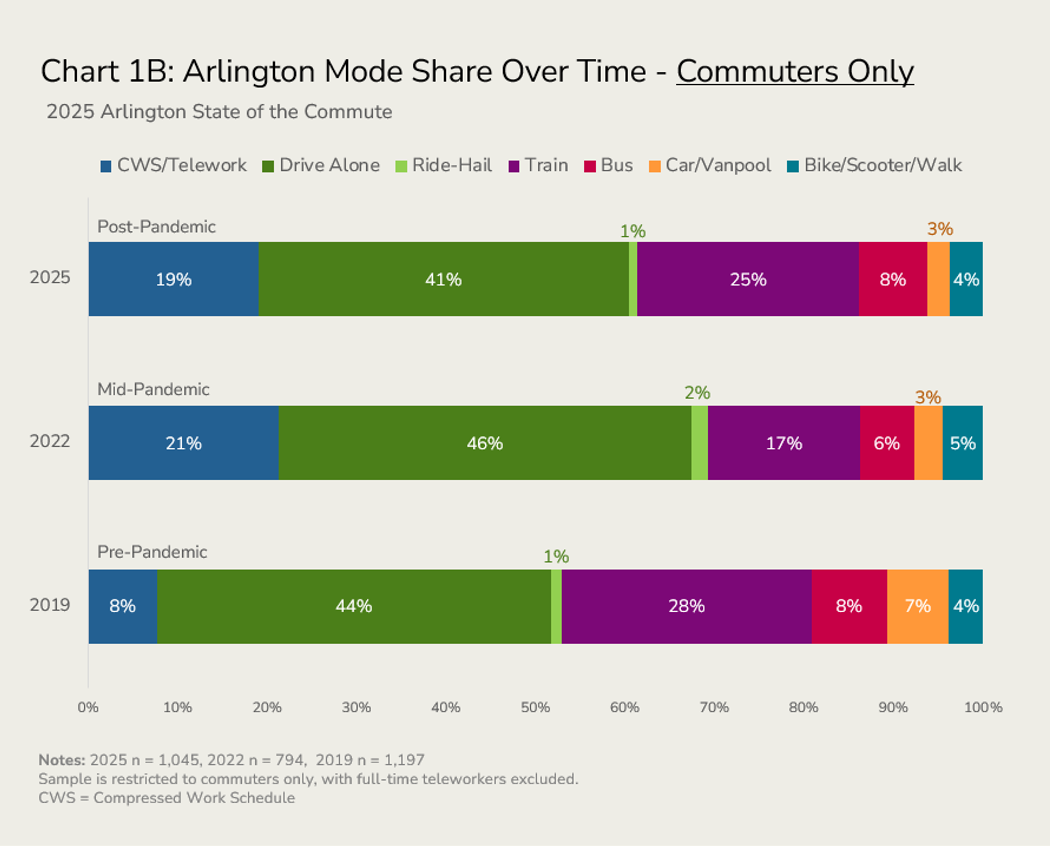
When restricting the sample to exclude full-time teleworkers in Chart 1B, we still see sustained increases in CWS/Telework among people who commute. The large fluctuation we saw in Chart 1 was driven by people adopting full-time telework then returning to office at least part time. We also see a slight decrease in driving alone compared to both pandemic and pre-pandemic levels. This decrease is near but does not meet the threshold for statistical significance. Public transit use is rebounding after a 36% decrease during the pandemic. As of 2025, public transit use is only 8% lower than the pre-pandemic benchmark among commuters.
Vehicle Quantity Over Time
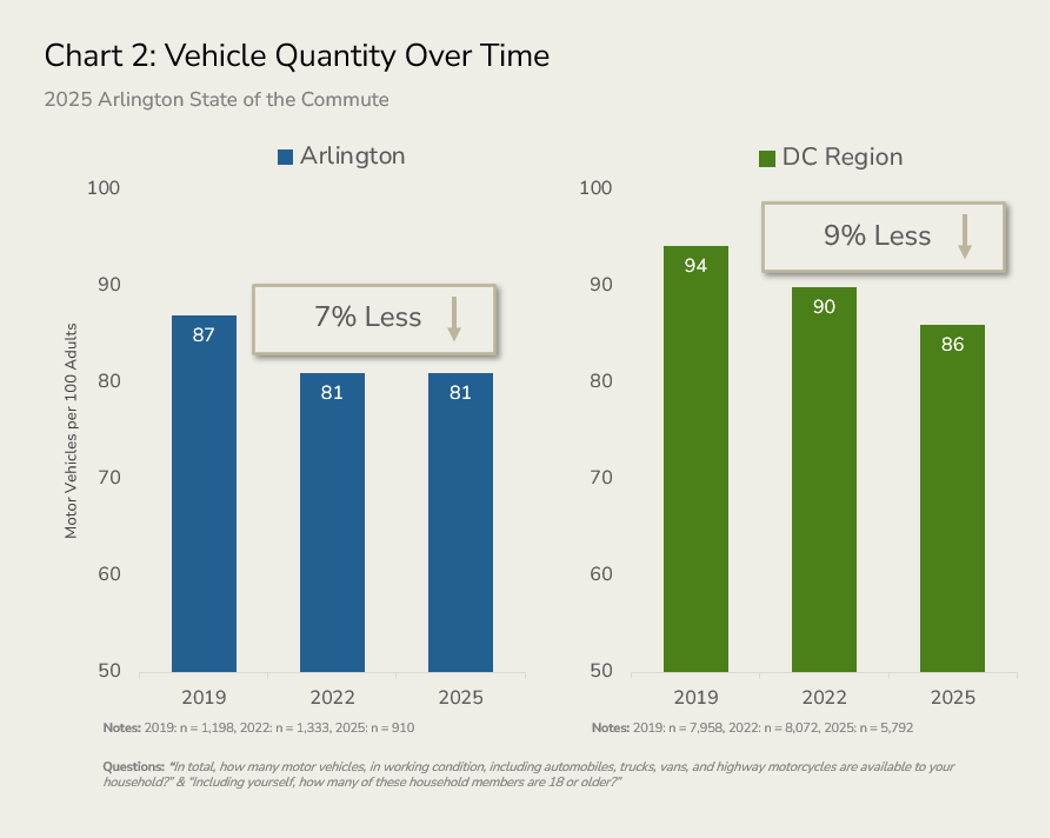
Both Arlington and the region as a whole exhibit measurable, statistically significant reductions in the number of vehicles per adult. Chart 2 displays this trend. Arlington workers report a 7% decline in vehicles since 2019. There are likely many factors influencing this trend, including the steep increase in the cost of vehicles since 2019. This is certainly a trend to watch.
Return To Office Policies
The 2025 State of the Commute Survey collected responses from March 27 to June 16. This period follows the wave of RTO policy announcements in Arlington and the region, and their subsequent implementation. In January 2025, the Trump administration issued an executive order requiring all federal employees to return to the office full-time. Additionally, Boeing, Raytheon, and Amazon had all issued full-time RTO orders by January 2025. The survey likely captured a large part of the commute changes brought on by RTO orders in Arlington County.
Survey respondents were asked if they had received an RTO order from their employer. Chart 3 summarizes their responses. Fifty-one percent reported “yes,” they’ve been ordered to return to the office; 35% reported “no,” their telework is unchanged; and 14% reported never teleworking. Of the 51% percent who reported RTO policies, 93% reported that the policy had already been implemented.
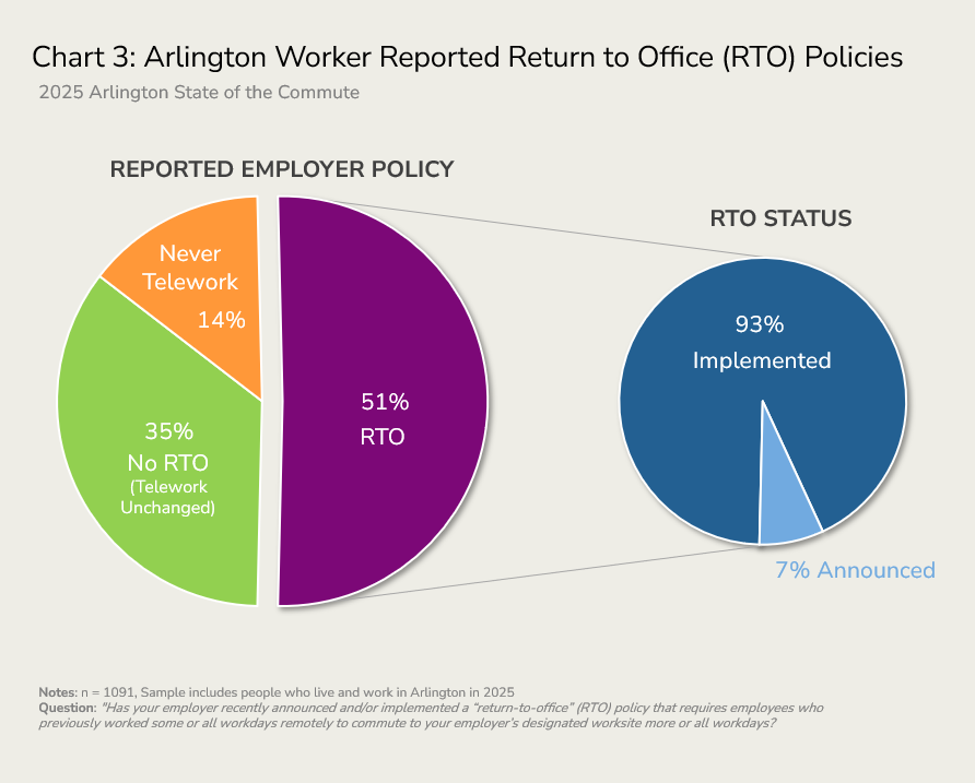
Chart 3B breaks down the responses about RTO policies by top employment sectors. When broken down by sector, we see that employees of federal agencies faced the greatest impact. Eighty-eight percent of federal employees reported receiving a return to office order. When including individuals who never teleworked, 94% of federal employees have no access to telework.
Workers’ Perceptions of Telework
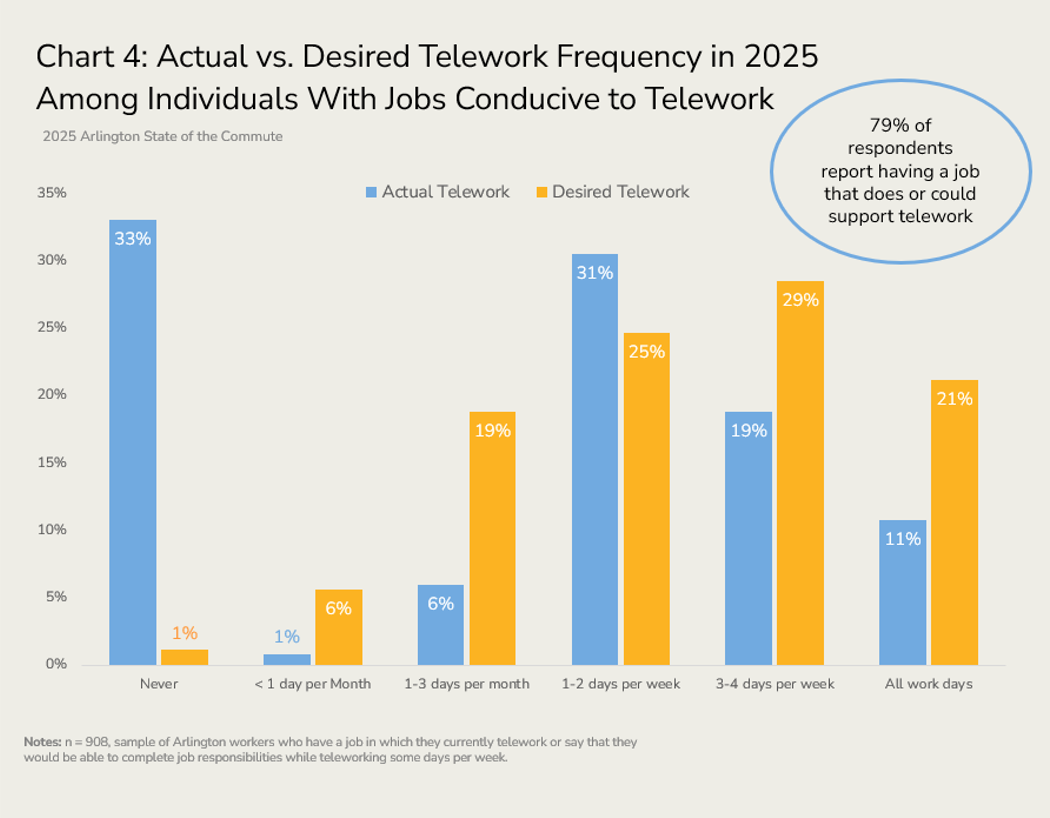
In 2025, there was a mismatch between how much telework workers want and how much they get, even among jobs with responsibilities conducive to teleworking. Among individuals with jobs that could be conducted remotely at least some of the time, 99% reported wanting telework, but only 67% had jobs that permitted any. Fifty percent of respondents want to telework at least 3 days per week, but only 30% have this schedule. Chart 4 displays the distribution of how many days of telework people want (in yellow) compared with the amount of telework their job actually permits (in blue).
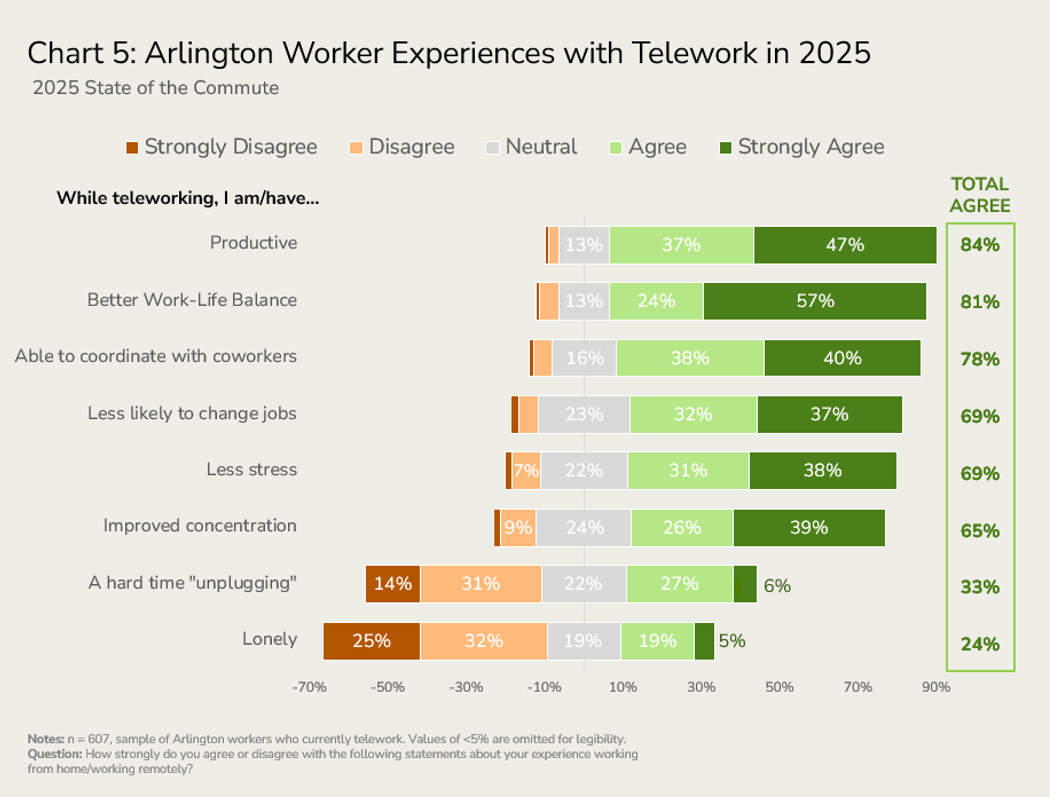
Respondents were also asked about their experiences with telework. Each distribution reflects majority positive outcomes with a relatively low proportion of people experiencing negative impacts. Employees overwhelmingly report being productive (84%) and having a better work-life balance (84%) while teleworking. A finding likely of importance to employers, 69% of respondents said they were less likely to change jobs as the result of having access to telework. Chart 5 summarizes the responses to all the questions respondents were asked about their experiences working remotely.
Conclusion
The pandemic had many impacts on Arlington County’s work practices and commutes, chief among which is a sustained adoption of telework. Even with 51% of Arlington workers reporting having received return to office orders as of 2025 (a trend disproportionately driven by individuals employed by the federal government) telework and compressed work schedules still replace 25% of commutes in the county. Telework also remains highly popular among workers who report greater well-being and better productivity.

| TRAC, formerly known as Commuter Services, will transition to a new contractor for Arlington Transportation Partners and Transportation Demand Management (TDM) services for Site Plans . The County is working to minimize disruptions, but brief delays in communications or services may occur during the transition. We appreciate your patience as we work to enhance these programs and services. For questions or assistance, please contact TRAC Bureau Chief Wendy Klancher at wklancher@arlingtonva.us. |